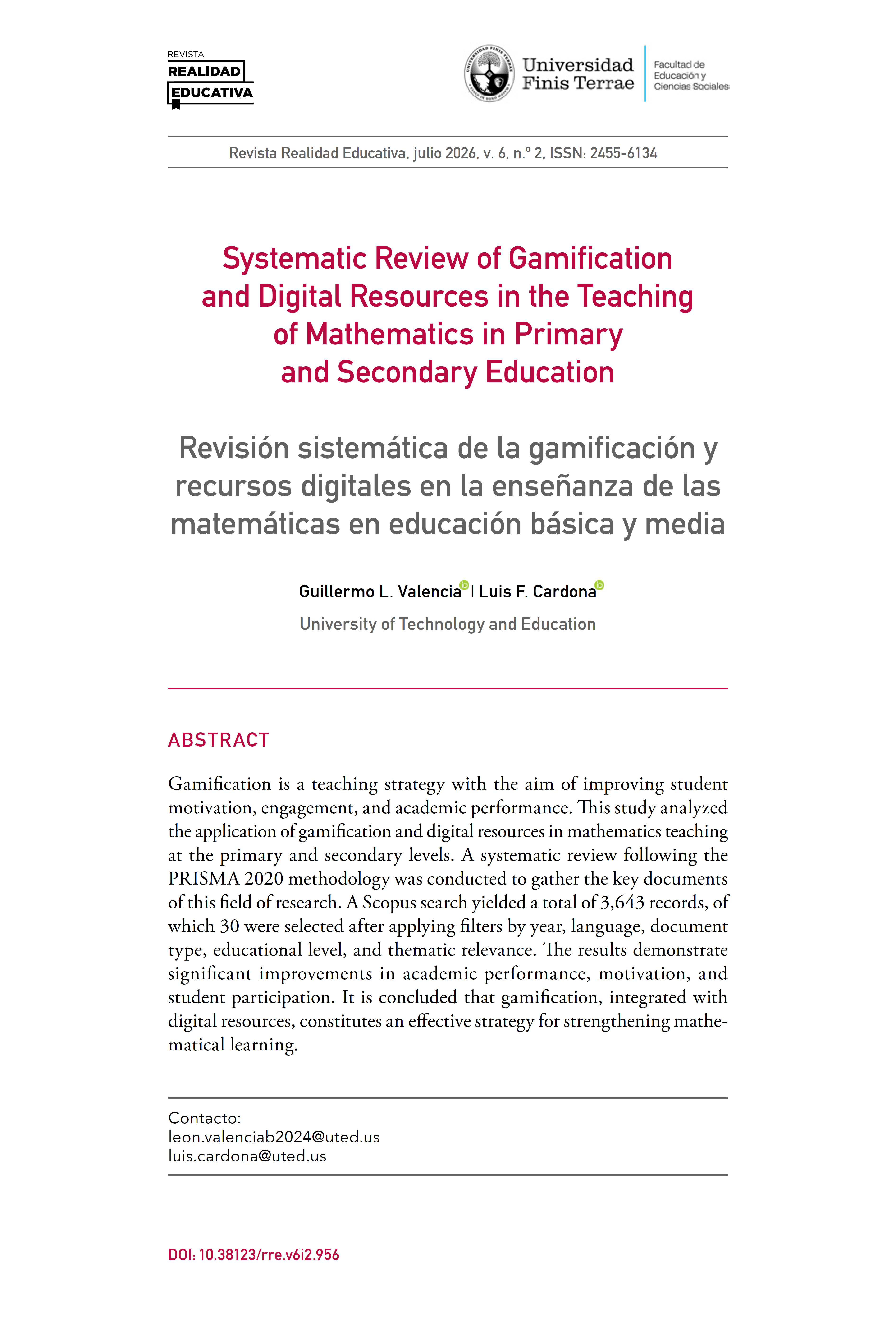
Systematic Review of Gamification and Digital Resources in the Teaching of Mathematics in Primary and Secondary Education
Keywords:
Gamification, education, math, primary education, secondary educationAbstract
Gamification is a teaching strategy with the aim of improving student motivation, engagement, and academic performance. This study analyzed the application of gamification and digital resources in mathematics teaching at the primary and secondary levels. A systematic review following the PRISMA 2020 methodology was conducted to gather the key documents of this field of research. A Scopus search yielded a total of 3,643 records, of which 30 were selected after applying filters by year, language, document type, educational level, and thematic relevance. The results demonstrate significant improvements in academic performance, motivation, and student participation. It is concluded that gamification, integrated with digital resources, constitutes an effective strategy for strengthening mathematical learning.
Downloads
References
Chen, Y.-C., Chao, C.-Y., & Hou, H.-T. (2023a). Learning pattern recognition skills from games: Design of an online pattern recognition educational mobile game integrating algebraic reasoning scaffolding. Journal of Educational Computing Research, 61(6), 1232-1251. https://doi.org/10.1177/07356331231171622
Chen, M. F., Chen, Y. C., Zuo, P. Y., & Hou, H. T. (2023b). Design and evaluation of a remote synchronous gamified mathematics teaching activity that integrates multi-representational scaffolding and a mind tool for gamified learning. Education and Information Technologies, 28(10), 13207-13233. https://doi.org/10.1007/s10639-023-11708-6
Ciapponi, A. (2021). La declaración PRISMA 2020: una guía actualizada para reportar revisiones sistemáticas. Evidencia, Actualización en la Práctica Ambulatoria, 24(3), e002139. https://doi.org/10.51987/evidencia.v24i4.6960
Cubillos, C., Roncagliolo, S., & Cabrera-Paniagua, D. (2023). Learning and motivation when using multiple-try in a digital game for primary students in Chile. Education Sciences, 13(11), 1119. https://doi.org/10.3390/educsci13111119
Da Silva, J. B., Júnior, F. P., Ribeiro, R. C., & Mauro, R. C. (2020). Mathematical mission: A ludical and motivate educational game. In 2020 15th Iberian Conference on Information Systems and Technologies (CISTI) (pp. 1-5). IEEE. https://doi.org/10.23919/CISTI49556.2020.9140985
De la Puente, M., & Pérez, H. (2023). Evaluación del impacto de Brilliant.org en la mejora del rendimiento académico en matemáticas entre estudiantes de secundaria en Colombia: Un estudio cuasiexperimental. Revista de Investigación en Docencia de Matemáticas, 15(2), 82-103. https://eric.ed.gov/?id=EJ1394390
Early, K. N. (2023). Gamification of mathematics instruction: A quantitative study on student growth and proficiency in a suburban middle school [Doctoral dissertation, Lee University]. ProQuest Dissertations & Theses Global. https://search.proquest.com/openview/a3177b745ed636dfa91a8e48f1e7396d/1
Efendi, A., & Qodr, T. S. (2023). Improving critical thinking skills of high school students through the implementation of mobile-based game applications. International Journal of Education and Practice, 11(3), 613-626. https://doi.org/10.18488/61.v11i3.3440
Escobar Pullutasig, G. E. (2024). Aprendizaje basado en problemas y operaciones básicas de la aritmética en los estudiantes de octavo año de Educación General Básica [Tesis de maestría, Universidad Técnica de Ambato]. Repositorio Institucional UTA. https://repositorio.uta.edu.ec/bitstreams/2cf7c388-6fc8-412f-82f2-c24ba1ad730e/download
González Martínez, L. (2024). Perspectiva de la didáctica de las matemáticas como disciplina científica [Trabajo de fin de grado, Universidad de Jaén]. Repositorio Institucional de la Universidad de Jaén. https://hdl.handle.net/10953.1/23125
Guaña, E. L. I., & Cevallos, P. A. E. (2024). La importancia del pensamiento crítico y la resolución de problemas en la educación contemporánea. Revista Científica Kosmos, 3(1), 4-18. https://doi.org/10.62943/rck.v3n1.2024.50
Guaypatin Pico, O. A., Fauta Ramos, S. L., Gálvez Cisneros, X. A., & Montaluis, D. (2021). La influencia de la matemática en el desarrollo del pensamiento. Revista Boletín Redipe, 10(7), 106-112. https://doi.org/10.36260/rbr.v10i7.1352
Gurjanow, I., Oliveira, M., Zender, J., Santos, P. A., & Ludwig, M. (2019). Mathematics trails: Shallow and deep gamification. International Journal of Serious Games, 6(3), 65-79. https://doi.org/10.17083/ijsg.v6i3.306
Holguin-Alvarez, J., Ruiz-Salazar, J., Manrique-Alvarez, G., Picoy Gonzales, J. A., & Holgado-Quispe, A. (2023). Mixed gamification with virtual tools modify poor school performance. International Journal of Evaluation and Research in Education, 12(3), 1663-1673. https://doi.org/10.11591/ijere.v12i3.25530
Hurtado, J. L., & Escudero Benavides, P. M. (2024). El impacto de las TIC en el ciclo de aprendizaje. Polo del Conocimiento: Revista científico-profesional, 9(1), 93-116. https://doi.org/10.23857/pc.v9i1.6370
Jiménez, C., Arís, N., Magreñán Ruiz, Á. A., & Orcos, L. (2020). Digital escape room, using Genial.ly and a breakout to learn algebra at secondary education level in Spain. Education Sciences, 10(10), 271. https://doi.org/10.3390/educsci10100271
Kamalodeen, V. J., Ramsawak-Jodha, N., Figaro-Henry, S., Jaggernauth, S. J., & Dedovets, Z. (2021). Designing gamification for geometry in elementary schools: Insights from the designers. Smart Learning Environments, 8, 36. https://doi.org/10.1186/s40561-021-00181-8
Kickmeier-Rust, M., & Niggli, C. (2023). Effects of gamifying mathematics lessons at high school level. In Proceedings of the 17th European Conference on Games Based Learning (pp. 319-326). Academic Conferences International. https://doi.org/10.34190/ecgbl.17.1.1593
Lee, J. Y., Pyon, C. U., & Woo, J. (2023). Digital twin for mathematics education: A study on the use of games and gamification for university mathematics education. Electronics, 12(15), 3207. https://doi.org/10.3390/electronics12153207
Lisondra, R. F., Jumawan, X. N. G., Anito, J. P. E., Abugan, G. R. B., Mira, R. J. T., & Patayon, U. B. (2023). eMATH: A gamified approach to arithmetic lessons. In 2023 International Conference on Innovation and Intelligence for Informatics, Computing, and Technologies (3ICT) (pp. 440-444). IEEE. https://doi.org/10.1109/3ICT60104.2023.10391559
Lizasoain Hernández, L. (2024). El análisis estadístico de datos en la investigación educativa. Revista Electrónica Interuniversitaria de Formación del Profesorado, 27(2), 217-232. https://doi.org/10.6018/reifop.608261
López Lattá, K. E. (2023). Percepciones y perspectivas de los futuros maestros sobre las matemáticas: Un análisis antes y después del curso de didáctica de las Matemáticas en un programa de Licenciatura en Educación Infantil [Tesis de maestría, Universidad Autónoma de Bucaramanga]. Repositorio Institucional UNAB. http://hdl.handle.net/20.500.12749/20814
Manzano-León, A., Camacho-Lazarraga, P., Guerrero, M. A., Guerrero-Puerta, L., Aguilar-Parra, J. M., Trigueros, R., & Alias, A. (2021). Between level up and game over: A systematic literature review of gamification in education. Sustainability, 13(4), 2247. https://doi.org/10.3390/su13042247
Mendoza-Vega, A. J. (2025). Los programas de gamificación en la educación: revisión sistemática. Episteme Koinonía. Revista Electrónica de Ciencias de la Educación, Humanidades, Artes y Bellas Artes, 8(16), 209-226. https://doi.org/10.35381/e.k.v8i16.4567
Negara, H. R. P., Wahyudin, W., Nurlaelah, E., & Herman, T. (2022). Improving students’ mathematical reasoning abilities through social cognitive learning using GeoGebra. International Journal of Emerging Technologies in Learning, 17(18), 118-135. https://doi.org/10.3991/ijet.v17i18.32151
Niño-Rojas, V. M. (2019). Metodología de la investigación: Diseño, ejecución e informe (2.ª ed.). Ediciones de la U.
Ortiz, W., Castillo, D., & Wong, L. (2022). Mobile application: A serious game based in gamification for learning mathematics in high school students. In 2022 31st Conference of Open Innovations Association (FRUCT) (pp. 220-228). https://doi.org/10.23919/FRUCT54823.2022.9770917
Page, M. J., McKenzie, J. E., Bossuyt, P. M., Boutron, I., Hoffmann, T. C., Mulrow, C. D., Shamseer, L., Tetzlaff, J. M., Akl, E. A., Brennan, S. E., Chou, R., Glanville, J., Grimshaw, J. M., Hróbjartsson, A., Lalu, M. M., Li, T., Loder, E. W., Mayo-Wilson, E., McDonald, S., … Alonso-Fernández, S. (2021). Declaración PRISMA 2020: una guía actualizada para la publicación de revisiones sistemáticas. Revista española de cardiología, 74(9), 790-799. https://doi.org/10.1016/j.recesp.2021.06.016
Párraga, A. P. B., Cedeño, E. L. H., Amores, C. G. R., Molina, A. D. A., Batioja, I. J. Z., Lloacana, M. Y. S., & Durán, V. D. R. C. (2024). La gamificación como estrategia pedagógica en la educación matemática. Ciencia Latina. Revista Científica Multidisciplinar, 8(3), 6435-6465. https://doi.org/10.37811/cl_rcm.v8i3.11975
Pozo-Velasco, A. J., Ramírez-Gutiérrez, C. V., & Martínez-Pérez, O. (2025). Use of active methodologies and information and communication technology (ICT) tools in education. MQR Investigar, 9(1), e1-e1. https://doi.org/10.56048/MQR20225.v9i1.1
Pradhan, S., Gurung, A., & Ottmar, E. (2024, March). Gamification and deadending: Unpacking performance impacts in algebraic learning. In LAK ’24: Proceedings of the 14th Learning Analytics and Knowledge Conference (pp. 899-906). ACM. https://doi.org/10.1145/3636555.3636929
Prieto-Andreu, J. M., Gómez-Escalonilla-Torrijos, J. D., & Said-Hung, E. (2022). Gamification, motivation, and performance in education: A systematic review. Revista Electrónica Educare, 26(1), 251-273. https://doi.org/10.15359/ree.26-1.14
Reif, B. A., Schluifer, K., Mayas, C., & Hirth, M. (2024). Analysis of gamification elements in e-learning. In P. Zaphiris & A. Ioannou (Eds.), Learning and collaboration technologies (pp. 94-112). Springer. https://doi.org/10.1007/978-3-031-61685-3_8
Ribeiro Filho, R. J., Cravino, J. P., & Lopes, J. B. (2023). Experiência gamificada na aula remota de matemática com a plataforma Quizizz. REICE. Revista Iberoamericana sobre Calidad, Eficacia y Cambio en Educación, 21(3), 23-39. https://doi.org/10.15366/reice2023.21.3.002
Rincón-Flores, E. G., Santos-Guevara, B. N., Martínez-Cardiel, L., Rodríguez-Rodríguez, N. K., Quintana-Cruz, H. A., & Matsuura-Sonoda, A. (2023). Gamit! Icing on the cake for mathematics gamification. Sustainability, 15(3), 2334. https://doi.org/10.3390/su15032334
Rumangkit, S., & Larasati, H. (2023). The role of gamification, perceived playfulness, learning engagement, and learning motivation on academic achievement in hybrid learning. E3S Web of Conferences, 426, 02002. https://doi.org/10.1051/e3sconf/202342602002
Sanabria, L. F. M., & Ordoñez, L. M. V. (2019). Edumat: Herramienta web gamificada para la enseñanza de operaciones elementales. Campus Virtuales, 8(2), 9-17.
Sarzosa, S. M., & Toaza, H. G. (2025). Gamificación con herramientas digitales para potenciar el aprendizaje y la motivación en el entorno educativo. Revista Social Fronteriza, 5(1), 1-17. https://doi.org/10.59814/resofro.2025.5(1)620
Setambah, M. A. B., Adnan, M., Zaini, S. H., Mujiasih, M., Hidayat, R., Ibrahim, M. A., & Hanazono, H. (2024). Impact of “Donkey”, “Snap” and “King” (DSK) non-digital gamification cards on fourth-grade students’ math performance in fractions. Infinity Journal, 13(1), 175-196. https://doi.org/10.22460/infinity.v13i1.p175-196
Singh, C. P., & Pathania, M. (2022). A gamified approach to learning the mathematical fraction concept: Evaluating the effectiveness and efficiency of the application. In 2022 2nd International Conference on Innovative Practices in Technology and Management (ICIPTM) (pp. 329-332). IEEE. https://doi.org/10.1109/ICIPTM54933.2022.9753922
Udjaja, Y., Guizot, V. S., & Chandra, N. (2018). Gamification for elementary mathematics learning in Indonesia. International Journal of Electrical and Computer Engineering (IJECE), 8(5), 3860-3865. https://doi.org/10.11591/ijece.v8i5.pp3860-3865
Vrcelj, A., Hoic-Božic, N., & Dlab, M. H. (2023). Use of gamification in primary and secondary education: A systematic literature review. International Journal of Educational Methodology, 9(1), 13-27. https://doi.org/10.12973/ijem.9.1.13
Vysotskaya, E. V., & Lobanova, A. D. (2023). Interstellar wanderers: Digital support for teaching place value within the activity approach framework. Psychology in Russia: State of the Art, 16(4), 21-36. https://doi.org/10.11621/pir.2023.0402
Yeh, C. Y. C., Yang, J. C. Y., & Chan, T. W. (2023). Design and implement an achievement system for enhancing students’ interest and self-efficacy in mathematics. In Proceedings - 2023 14th IIAI International Congress on Advanced Applied Informatics (IIAI-AAI 2023) (pp. 703-704). IEEE. https://doi.org/10.1109/IIAI-AAI59060.2023.00142
Young, J. R. (2023). The role of technology in enhancing urban mathematics education. Journal of Urban Mathematics Education, 16(2), 1-13. https://doi.org/10.21423/jume-v16i2a589
Zainuddin, Z., Chu, S. K. W., Shujahat, M., & Perera, C. J. (2020). The impact of gamification on learning and instruction: A systematic review of empirical evidence. Educational Research Review, 30, 100326. https://doi.org/10.1016/j.edurev.2020.100326
Published
How to Cite
Issue
Section
License
Copyright (c) 2026 Guillermo L. Valencia, Luis F. Cardona

This work is licensed under a Creative Commons Attribution-NonCommercial-NoDerivatives 4.0 International License.
Los contenidos de esta revista se distribuyen bajo una licencia Atribución/Reconocimiento-NoComercial-SinDerivados 4.0 Internacional.